Showing posts with label Alonisos. Show all posts

Saturday, 12 January 2008

A Tale of Two Dogs... OR Alonissos Travelogue Part 20

And so we come to the last post in what has become something of an epic travelogue of my time on Alonissos. Like I said a couple of posts ago, I never meant to write something as long as this. In fact, this whole thing began life a post holiday email to Dave and Gerry describing a couple of photos that I had taken whilst walking around their island. It only became a travelogue proper when they suggested including these comments as part of a 'visitor's travelogues' addition to their site, at which point I thought I should write something more befitting of the genre 'travelogue'.

In this, the last of my posts, I do not intend to describe a walk for the simple fact that there are no more to describe! I only did four routes of the many that are described in the two guides that I have mentioned... perhaps next time I will add to this tally. Instead, what I would like to do is tell you the story of how I left the island. I had to leave the island suddenly and before I had planned on account of receiving some bad news. However, the sadness of this time was offset by more than enough happiness... as is always the case provided we look hard enough.

* * *

As you may recall, my job, being that of an English teacher, allows me plenty of free time to escape Germany and live the simple life camping and trekking under the sunny skies of the Aegean. However, not everyone can afford the luxury of 6 weeks summer holiday every year - especially if they are a doctoral student of archaeology in the middle of their Phd - and it was for this reason that I was holidaying alone on Alonissos without the company of my wife. For Maria's part, she had decided four weeks was all she could spare from her studies and so would fly out two weeks after me when we planned to go on a kind of busman's holiday, touring the archaeological sites of Minoan Crete.

I completed the fourth walk, the walk through the Kastanorema gorge, some time early on in my second week on the island and although I had walked a lot, there was still a lot more walking to be done. Leafing through my walking guide late that evening whilst sitting in a taverna in Patitiri finishing off the last of my retsina, I considered my next outing... I had still to explore the western and northern regions of the island. Perhaps I could do a walk taking in the area around Megalo Horafi or Tourkoneri? Perhaps I could rent a bike again and drive up to the northern tip of the island to walk round Yerakas? Or perhaps I could take a boat to one of the satellite islands? I could easily spend another week here!

Rising from the taverna with a yawn, I started out on the walk back to the campsite stopping, as was my custom, at the phone box next to the ruined hotel Galaxy to give Maria a ring.

The minute she picked up the phone I could tell that something was wrong... I could hear from the sound of her voice that something very bad indeed had happened.

"What's the matter... what's happened?" I inquired.
"Lara died", the answer came back.

Lara was the family dog, a little tan coloured sausage dog who had lived with her at the family home in Athens since she was a child. Now that she lived abroad, she only got to see her during summer vacations when typically she would spend the whole morning lavishing attention on her velvet belly. Quite simply, she loved that little dog, as did the whole family, and this was going to be difficult, especially given that she was all alone up there in Germany.

It was frustrating. That it should have happened was bad enough; but for it to have happened when we were apart, just a matter of a weeks before we were due to visit the family home again was particularly cruel. It was a helpless situation... so we did the only thing we could do to take back some measure of control. She would change her ticket and we would meet in Athens in 2 days time.

This gave me one more full day on Alonissos, and I knew exactly what to do with it. Some days previously Dave and Gerry had asked me to get in touch with them before I left the island such that we could have a final lunch together. So I called them to tell them the news and arrange to meet them the next day in a restaurant near Paliohorafina.

It was always a pleasure to spend time with Dave and Gerry, not least of all for the insights they afforded me into everyday island life. But it was particularly nice to see them at this time. Not only did I need someone to talk to about our little tragedy, it turned out that they had some news for me to put things into perspective... they had just 'acquired' a little dog of their own.

As the reader of their website will no doubt know, like many of the ex-pats living on Alonissos, Dave and Gerry are actively involved in the local animal charity ASAP. More than this, if you get the chance to loiter in their yard, you might find yourself experiencing a little difficulty moving for the number of cats milling about! It was no doubt in their capacity as animal caretakers that they had begun to look after a very young stray dog that they had found scrounging for food with the cats outside local tavernas. It now seemed that they had finally taken her in as their own having assured themselves that she was indeed homeless and having just gotten her checked out by a vet.

And the name they had given to her? Zoe, a name which most readers will immediately recognise as the Greek for life.

It was a fitting end to my time on the island, to get a little boost just when it was required and under such poignant circumstances.

And with that, I bring this travelogue to a close.

A quick visit to Garbitses... Or Alonissos Travelogue Part 19

Leaving Mourtitsa at about 6 o'clock, I was still more or less on schedule for my evening ritual of showering, dressing for the evening, and sipping an ouzo outside my tent. But there was still one thing that I wanted to see now that I had the Vespa: the archaeological site of Garbitses.

I don't really know why: I knew and still know nothing about the site, despite numerous internet searches. So if anyone can illuminate me as to the significance of the site, I'd be grateful. But I think that I mostly wanted to see it because it was an archaeological site and my wife would be disappointed if I neglected to visit it.

Signed off the main road on the way back, I drove carefully up the dirt road on my trusty Vespa until I came to a sign by the side of the road directing me the last 100 meters or so through scrub and olive groves to the site itself.

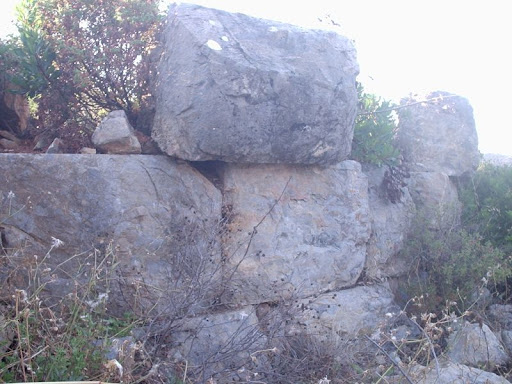
I almost missed it. The fact of the matter is that there really isn't all that much to see, just these blocks:


And no matter how much I nosed around, overturing stones and parting the fronds of ferns, I just couldn't find anything else.

However, if the site wasn't exactly the most interesting that I have visited, I was compensated by the surroundings. Standing next to any ancient stones in the early evening, high up on a hill side facing the sea is always an experience.

And so is an alfresco ouzo back at your tent after a long day's walking... so with this on my mind, I left Garbitses and headed back to the campsite.

The Yellow Route: "I just did a little circle hereabouts"... OR Alonissos Travelogue Part 18


I didn't mean to walk the Kastanorema gorge... it just kinda happened.

You see, when I left Mourtitsa I was only curious to see what the gorge looked like. Besides, it was a little late to be attempting an unaccompanied 4 and half hour walk up a gorge. If I did choose to do it, I would get back to the campsite at something like 7 o'clock and that just wouldn't do. You see, as is always the case when camping on the islands, I had gotten into this comfortable routine. Morning and afternoon were for walking; but 6 o'clock and the softening colours of dusk were for showering, dressing for evening, reading the paper, listening to my little pocket radio, low key socialising round the communal fridges and, or course, libations. `So you see I really couldn't set out on this walk...

But it was a terribly nice path, heading north with the sea to my right and the mountains to my left. In short, it was a coastal path and therefore just the kind of walk a like.

And the landscape was just that little bit different. Gone were the pines and olive trees, to be replaced with low lying strawberry-trees and hollyoaks. And here in the northern half of the island was an unfamiliar seascape of scattered islands whose forms I hadn't yet encountered.

And there was this surprisingly appealing sense of isolation, made more intense with each step away from Mourtitsa.

In short, I wasn't focused on any goal and so time seemed simply to fly by until such a point when the landscape opened out in front of me to reveal an extensive area of flat pebble and boulder strewn land sandwiched between two low hills and the sea. I had reached the mouth of the gorge.

It occurred to me that now that I knew just how pleasant a walk it was I could come back next year with my wife and walk the rest of the way together. But I should probably find the onward path through this mass of pebbles and boulders to the start of the gorge proper, there had to be some way markers here somewhere. Perhaps if I follow the thin depression of the river bed?

Heading inland on the dried up river bed, the slopes of the low hills on either side of me gradually began to close in and rise above me. As they did so, the sound of the waves disappeared and the clicking-clacking of the bone dry pebbles displaced beneath each step I took got louder and louder. If silence can have a sound, this was it. There was no one, not a soul around.

Now this was beginning to feel a bit special, a bit like you feel while standing on a cliff top looking out to sea; a bit like being drawn inexorably into something wild yet totally alluring.

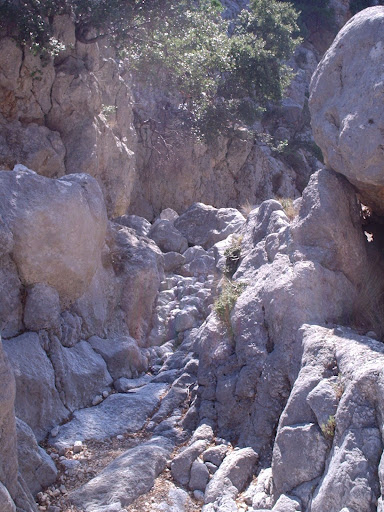
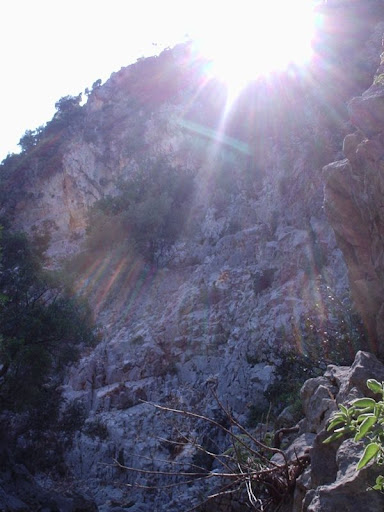
And it got better. Down in the gorge, things started hotting up as the walls closed in higher above me and the pebbles beneath my feet gave way to sheer rock face gouged and polished by heaven know how many years of flow, and it was round about when I took these two photographs that I decided to hang with the evening ritual; this was simply too special a walk to turn back on.

Stream channel, Kastanorema gorge.

Overhanging gorge wall, Kastanorema gorge

So I ended up adding the Kastanorema gorge to my list of conquests upon the island, and it was quite fitting that this last walk should be the most dramatic.

Other than extol the drama and thoroughly romantic sense of isolation that the walk engenders, I should probably give the prospective walker a rundown of highlights and advice:

1. The walking guides are right: once you are in the gorge there is no way you can get lost. Also, for the most part, the terrain is smooth rock or boulders. I walked up the gorge in a pair of trekking sandals so it really isn't the most demanding of walks underfoot.

2. There are snakes in the gorge. I disturbed a couple on my way up which slithered away as I clumsily came tramping through their domain. They looked to be the same species and of a light turquoise colour. I've just done a google image search to find out what species they are and if they are poisonous but to no avail. Very beautiful though.

3. At about the half way point, the stream bed becomes quite shallow with scrub and shrubs to the sides which at some points meet overhead forming a little arboreal tunnel for you to walk through. Further on, the stream bed becomes shallower still to the extent that you can see the landscape clearly on either side. At this point you should look out for a daub of red paint on a rock to your left indicating that you should leave the stream bed. It's quite obvious but best to be extra aware when the landscape starts to flatten out.

After this point, you walk through a little olive grove to emerge at a dirt road with a watering point for goats facing you. At this point, there is a sign post directing you up onto a little path which gently ascends the hill in front of you.

Now at this point I had been walking for about 3 hours or so having made good time in the gorge. I was, however, a little disorientated having been effectively blinkered by the high walls of the gorge such that I didn't know in which approximate direction the sea might be found. It was far from a worry however as the path was obvious as well as being periodically signposted.

In fact, it made the scene that greeted me as I rounded the crest of the hill all that more impressive for being unexpected:


As the landscape flattened out at the crest of the hill, I was greeted by this field of wild thyme and the realisation of just where I was. Here in front of me I could see the familiar form of Peristera: I had reached the top of the hill behind Agios Dimitrios, which was spectacularly confirmed when I walked down this path and looked down:


Like I said, Agios Dimitrios is best viewed from above.

If ever you find yourself on Alonissos with your own transport at dusk in late June, you could do worse than drive up here (a dirt road off the island's main road north terminates just beyond this point). If you do, I would heartily recommend a bottle of chilled white wine and the company of someone special to share the view and what must be a royal carpet of wild thyme in bloom.

The final leg, down off the hill and back to Mourtitsa where I had left the Vespa was accompanied by a song and the inquisitive looks of mountain goats. Slowly, the triangle of land that was Agios Dimitiris grew bigger and closer until I was a matter of minutes from the coast. Unfortunately it was at this point that the surrounding scrub grew tall and so thickly knit that the path was at some points virtually unpassable. But passable it was, and jumping down onto the dirt road along which I had driven about 3 and 3 quarter hours before, I met a Greek couple out for a stroll.


"Apo poy pidixes?" = "Where did you spring from?"
"Molis ekana ligo kyklo edho gyro gyro" = "I just did a little circle hereabouts..."


And with that they wished me kali ekdromi, took their leave, and left me to pick up the Vespa to drive back to Patitiri... by way of just one final distraction.

Friday, 11 January 2008

A little persuasion goes a long way... OR Alonissos Travelogue Part 17

Taking once more to my little pig, I left Kokkinokastro behind and continued my journey slowly north toward Agios Dimitrios. Having travelled for about twenty minutes or so, I was by now familiar with the machine, and all in all the drive was shaping up to be a very pleasant one -- not least of all for the sense of intimacy that I felt for the environment having tramped all around it for the past week.

But then the inevitable happened... Like I told you, I have never had the most successful of relationships with motorbikes and it seemed that it was now time for us to have our bi-annual falling out...

There I was driving up the hill before the descent to Steni Vala when suddenly, for no reason as far as I could tell, the engine stopped and I ground to a halt on a bend. Once, twice and three times I tried the ignition but to no avail. It was no good. So, pushing her off the road I worked on the kick start, but even then the little pig refused to grunt for more than a couple of seconds. It was useless, no matter what I did or how patient I was the little swine was not for moving... by conventional means at least. But I wasn't going to let her have it all her own way. No sir-ee.

Grabbing her by the handlebars, I marched her puffing and panting up to the crest of the hill before the descent to Steni Vala, which took some doing on account of considerable bulk. Then, gently urging her forward over the crest, I hopped on her back and let gravity persuade her that maybe it would be best to cooperate with me after all. Almost immediately, she began to see it my way and so coasting along quite smoothly, we reached Steni Vala in a matter of minutes.

On reaching the harbour, I made a quick phone call and me and my little pig were separated... which could only have been for the best... and I got myself a newer, more reliable model. But unfortunately, someone had forgotten to inform the mechanic at the rental shop of my track record on two wheels as my replacement was not a quad-bike but a Vespa.

After everything that had happened I was in no position to argue, so simply took the keys, waited for him to get out of sight, took a deep breath and climbed on board. And then it was off to Agios Dimtrios with my mantra ringing in my ears: "don't fall off... don't fall off... don't fall off... don't fall off..."

And, to my credit, I didn't.

In fact, it was a really nice drive, taking it easy along a quiet road north from where I had reached the previous day, with the sea lapping a thin strip of beach to the right beginning just where the asphalt finished. All too soon, I arrived.

Agios Dimitrios, of course, is famous for its shape: a triangle of pebbly beach pointing out to sea in the direction of Peristera. As we will see later in the next post, it is best photographed from a position high up in the hills behind it, but I just couldn't help snapping the 'apex' if you will of the triangle up close:


If you look closely at this photograph you will probably be able to make out a dark blob on the beach to the left of the photograph. Once more, this is a sea urchin and once more, great care needs to be taken while swimming in the waters here as the seabed was simply full of the little blighters. (And once more I dived in without a care and was merrily splashing away quite the thing before I realised this was so... )

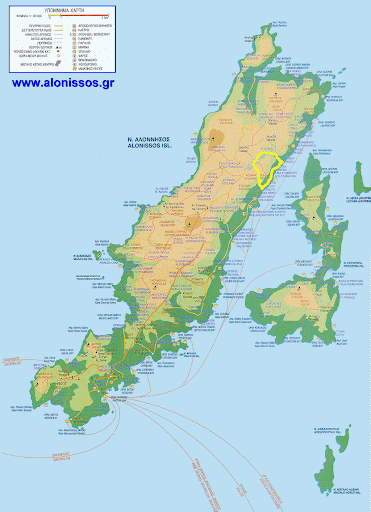
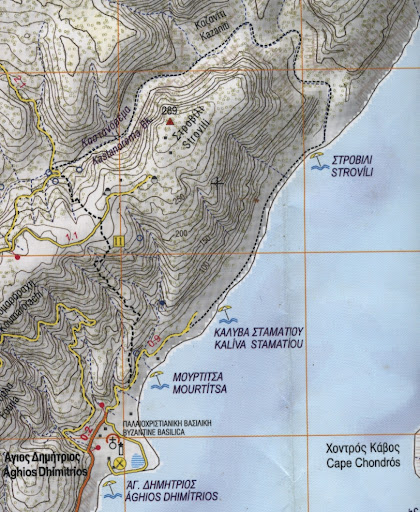
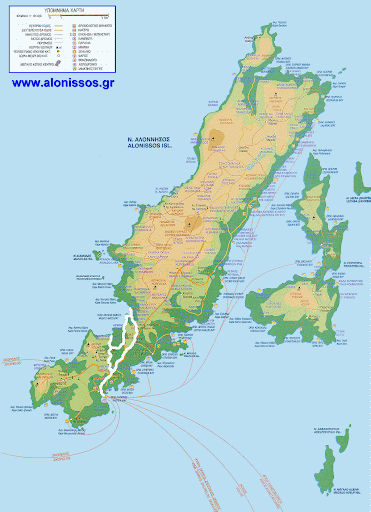
What else of Agios Dimitrios? Well, it is exceedingly picturesque, with good swimming and enough beach space to cater for all those who, understandably, are attracted to one of the best beaches on the island. However, if you are looking for a little more peace and quiet, can I suggest the little beach of Mourtitsa just a ten minute walk north? You can see how to get to it from this map:


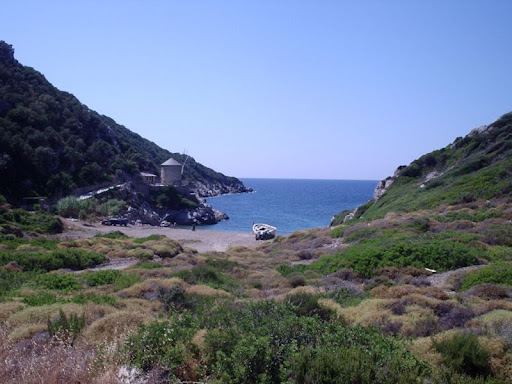
As you can see, the main road ends at Agios Dimitrios but a dirt road (here marked in yellow) continues as an access road to a villa for rent which overlooks Mourtitsa. After taking a dip a Agios Dimitirios, I drove the short distance up here and was very impressed with what I found. Basically, Mourtitsa consists of a single old style villa complete with balcony of flowers looking out over the strait to Peristera above what to all intents and purposes is a private beach. And to top it all, a picturesque rowing boat lies hauled up on the little shingle beach below, just picture perfect. So much so that I spent another half an hour here on the beach just dozing and dipping... and no sea urchins!

This travelogue has been a long time in the writing, especially considering the fact that it originally started life as a hasty email to Dave and Gerry cobbling together the bullet pointed highlights of my trip to their island. But we are almost at the end. It only remains for me to describe my fourth and last walk on the island, the walk depicted here on the map above by a broken line heading first north from Mourtitsa before looping inland and round the bulk of mount Strovili, to lead back once more to the coast -- the walk through the Kastanorema gorge.

Thursday, 10 January 2008

An unexpected surprise at Kokinnokastro... OR Alonissos Travelogue Part 16

Pulling out of Patitiri on the back of my little goyroyna, I had a plan. My travels to date had seen me take in a substantial swathe of the island's terrain; but I had yet to explore those worthy attractions in the more northern part of the island. From both my pre-holiday research and my occasional meetings with Dave and Gerry, I knew that no visit to Alonissos would be complete without a trip to the beaches of Kokkinokastro and Agios Dimitrios. I was also intrigued by the archaeological site of Garbitses and furthermore by the Kastanorema gorge... it was to be another full day.

My first stop was Kokkinokastro. A short drive north on the main road, it was an opportunity to ease myself into the saddle of my little pig. Arriving without event, I de-saddled, parked my little friend under a tree out of the fierce sunlight and headed down to the beach.

Consisting of a high triangular outcrop separating two picturesque and sheltered beaches, Kokkinokastro was bound to be busy on this, one of the last days of July. And sure enough, as I reached the bottom of the lane, the beach was crowded with holiday-making families, umbrellas and the like. However, it wasn't the opportunity to bathe that brought me here, but an interest in the arachaeology of this site. From the few resources I could find about it, it seemed to be a site with a long history and one which some claim to have been the Ikos or ancient capital of Alonissos. Certainly from the topography of the area one can imagine that such a high outcrop would have attracted the attention of ancient peoples. However, it is worthwhile noting that the present day coastline bares little comparison to that of the past. Looking at Kokinnokastro today the sea licks its shores; but it is arguably the case that centuries of earthquakes and subsidence have served to raise the sea level in the area to its present position and that there is good reason to believe that the site would not have appeared so impressively well-defended in earlier times.

However the fact remains that it is extremely well defended today... so much so that I was unable to access the triangular outcrop no matter from which direction I approached! My apologies for using such a low quality image of the site, but it really only is with an aerial view (as is provided by this postcard) that one can appreciate just how impenetrable this site is today.


The beach I have described is the one that you can see here... even with such low resolution I am taken aback at how nice it looks! But to get back to the point, as you can see, it is impossible to gain access to the raised triangular outcrop from the beach itself. You either have to swim out and look for a way to clamber up the rocks on the seaward facing side, which is equally steep, or somehow get up to that little spine of earth that connects the outcrop to the island proper and walk across it. This was my plan, so I found a way through the trees you can see here (actually someone's garden!) to the edge of the spine. But when I arrived and took a good look at it, I knew that it would be impossible to cross: it was just to sheer.

Undaunted, I carried on through the trees to the other side of the outcrop to assess the situation here. Perhaps here I could find a way to access the site?.. no dice... it was the same story on this side: steep rocky slopes. However, I was compensated for my trouble with this:


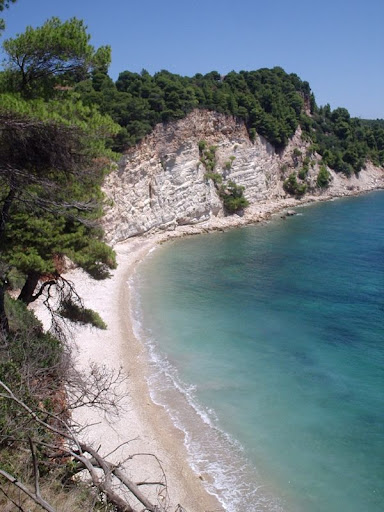
With a picture like this, you don't really need words but me being me I have to say something and that is this: thank God that Greeks, on the whole, value sun-umbrellas, company and the proximity of a cantina over such isolation... for people like me (and, I suspect if you are still reading this, you) it is a perfect trade off.

Wednesday, 9 January 2008

Four wheels or nuthin' at all... OR Alonissos Travelogue Part 15

I have never really had the most successful of relationships with motorcycles. I got my one and only motorcycle at the tender age of 19. It seemed a good idea at the time... along with purple shoes, lamb-chop sideburns and 32 inch flared levis. I should have seen the omens coming... it absolutely poured it down the day I picked it up from the bike shop, so much so that I felt I should make my way back to my little village on the back roads on account of the fact that there would be less traffic for me to collide with. When I finally got to the end of my street, soaking wet and very much in need of a hot bath, the local village idiot decided to cross the road between two parked cars without looking and wham! That was my first accident. To be fair, it wasn't my fault... my light was on and I was driving as cautiously as I could without actually getting off and pushing the thing home... but it was not a good omen. My second spill came about a month later on the back roads near Loch Lomond. It was the height of summer and I had just spent a thoroughly pleasant summer's afternoon by the Loch, alternately swimming and reading Lolita and was now driving home to meet up with some friends when wham!... A car full of young guys out on a joyride sped round a corner giving me the fright of my life and causing me to make a sharp left turn into the kerb. As the front wheel clipped the kerb I lost control and down I went, skinning my knees, denting the petrol tank and ruining my favourite pair of flared trousers. But the last straw came one summer, years after, when I was travelling round Crete. I had found myself in Matala and, tired of relying on busses and the limited number of coastal resorts that they could take me too, had hired a scooter to take me inland. I had it for 3 days and the plan was to tour the interior in a huge circle, driving by day and sleeping out in some olive grove by night. As it was only a scooter, I planned to travel light: just my sleeping bag, a hammock and a change of clothes for the evening. Otherwise I would be driving in my sandals, swimming trunks, shades and bandana... note the lack of helmet. ... I didn't get very far. I had only been driving for about fifteen minutes when I saw a sign for a beach. Heading down a quiet asphalt road early in the morning, I opened up the engine a little more than I should and before I knew it was fast approaching a tight right hand bend. Pulling on the brakes, I tried to swing the bike out to the left such I could drive into the bend at my higher speed, but at the moment I hit some gravel and the front wheel skidded out from underneath me, throwing me down hard onto the asphalt. I hit the road with my head and skidded on my unprotected limbs for a while before finally coming to a bloody halt somewhere in the middle of the opposite lane. I didn't feel any pain at first, just shock and the shame of being such a fool... again. Jumping to my feet I walked unsteadily over to the scooter, it's engine still running, to survey the damage. It was then that I noticed a lot of blood was gushing down over my eyes from an open wound in my head... but this seemed to matter less than getting the bike off the road. It was as if hiding the evidence of my stupidity from passing cars would somehow undo the damage... I guess I was in shock. Stemming the blood flow with my bandana, I wheeled the bike into an olive grove, then gingerly pulling back the bandana, checked my head wound in the broken mirror of the bike... there was a big hole in my head... there was no way I could just pop back on the bike again and carry on as if nothing had happened; from previous experience I knew that this needed to be cleaned and stitched. Besides, the wounds on my limbs were pretty extensive too and they too were beginning to hurt. I don't know how long I spent alone in that olive grove with only my conscience and and ever more keen sense of pain to keep me company, but I do know that I was eventually discovered by the driver of a rubbish truck who kindly informed the bike company and called me an ambulance. But once again I had to wait alone in that olive grove, replaying the incident; dealing with it. I swear I could have kicked myself with shame... if I had been able to find a part of me that wasn't bleeding already. One X-ray, five stitches, a trip to the rental office and 100 euros later, I sat in my sleeping bag in a hammock strung between two trees on the campsite in Matala. My wounds had been sprayed but not bandaged as they needed to breathe, which left them at the mercy of every insect that happened to be passing that corner of Crete. They had also started to tighten to the extent that I did not have the necessary flexibility of movement to put up my tent in what was a stiffening breeze. So that night, I slept out in a hammock, sweating in a sleeping bag that had to be zipped up tight to protect my wounds from flies. I say slept, but closer to the truth would be agonised... both on account of the pain and over what might have been. It was then or then-abouts that I made a promise to myself never to ride a motorcycle again, and to my credit it was a promise that I managed to keep... until I got married. I got married in August of 2006 on the island of Anafi, a simple ceremony in the village mayor's office with only a handful of friends to witness it. The day after the wedding the point was mooted that it might be a good idea to rent some bikes and head off on a tour of the island; or, to be more accurate, everyone apart from me was dead keen on the idea and I was beginning to look like a bit of a party pooper. So bowing to pressure and participating in the spirit of the occasion, I broke that promise. Needless to say that carrying my recently acquired wife on the back of the bike as pillion passenger was more than enough incentive to take it very easy indeed. However, just because I was the very model of the careful driver didn't mean that I wasn't, at times, haunted by the prospect of... well... falling off. Indeed, the very fact that I was responsible for my wife's welfare too only served to heighten my anxiety. So in a nutshell and like I said, I have never really had the most successful of relationships with motorcycles. That's why when I went to the bike rental office that morning in Alonissos I walked in asked them...
"Mipos ehete mia goyroyna?"
Strictly translated this means: "Do you happen to have a sow (as in a female pig)?" But you will no doubt better understand my meaning when privy to the knowledge that this is the name that Greeks give to those sturdy, grunting off-road quadbikes.
Now that my responsibility had been halved since that last time I drove a motorcycle, I was taking no chances: it was four wheels or nuthin' at all.

Monday, 7 January 2008

The Pink Route: 3 beaches, 2 turkeys and a bus back home... OR Alonissos Travelogue Part 14

The onward route from the stable where one emerges out onto the Isomata plateau down to Steni Vala rivals that of the first leg of the red route for one of the most scenic of the island. Not only is one high up on a plateau with ever more expansive views of the neighbouring islet of Peristera, the landscape of the plateau itself represents a stark contrast to most of the rest of the island with its red earth interposed between rutted grey rocks... not to mention its forest of cedar trees.

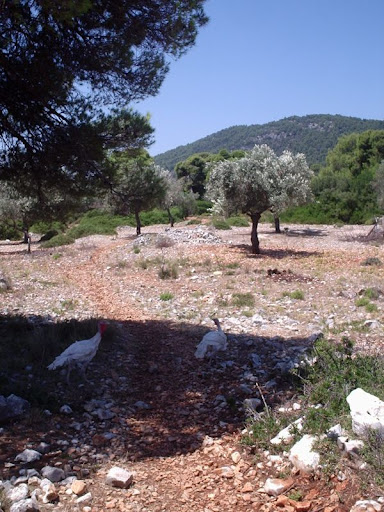
However, searching my photos of this part of the walk it was the sight of two turkeys which appeared out of nowhere to strut 'neath the shadow of pine tree that seems to have arrested my attention!


The cedar forest is worth another mention, which is not to say that the trees are tall; but rather that they are so thick and densely packed at times that with a little bit of imagination one might believe one was wandering in a maze! No doubt for this reason, the descent down off the Isomata plateau through the cedar forest is one of the most well-marked of Alonissos' routes with yellow and black poles supplementing the familiar red splotches of paint upon rocks. I should also add that half way down (or of course half way up) there is a beautifully situated picnic bench with great views of Peristera from amidst the cedars... just the thing for a nice evening picnic watching the exposed rocks composing the neighbouring islet taking on an ever more intense and firey hue.

On reaching the foot of the hill, a dirt road greeted me and led me after five minutes to Agios Petros beach, the beach neighbouring Steni Vala. Although it was a little difficult to find the beach at first given the amount of residential buildings crammed into the land behind the beach (I took a few wrong turns here into the yard of a private house) I eventually found the unsigned way down to the water through a garden there to bathe a while and enjoy the tranquility of one the islands more sandy, if small, beaches.

However, soon curiosity go the better of me and, seeking shelter behind a low wall, I changed out of my swimming shorts and back into my walking trousers to take the path for the final five minutes or so round the headland to the next bay of Steni Vala.

As Alonissos goes, there isn't really much in the way of accommodation, facilities or indeed substantial habitation besides Patitiri and the Hora. The notable exception to this is of course Steni Vala, a little anchorage catering for summer yachts with a couple of tavernas, cafes, a shop and even accommodation options which extend to a fairly large campsite. It was this latter feature which had attracted my attention many months before when I was casting around for a summer holiday destination which would allow me a range of camping options. In fact, I had at one point planned on heading straight for Steni Vala on arriving on the island for fear that the southern half of the island might be over-run with tourists given the time of year. In the event, this was far from the case; I had settled in well at campsite Rocks and was very much enjoying my quiet little patch. But still, I was curious to see what this other site had to offer. Very seldom do you find an island the size of Alonissos with two campsites and I felt I might just be tempted to move here for my second week on the island, or at least have it as a viable option for a future visit to the island.

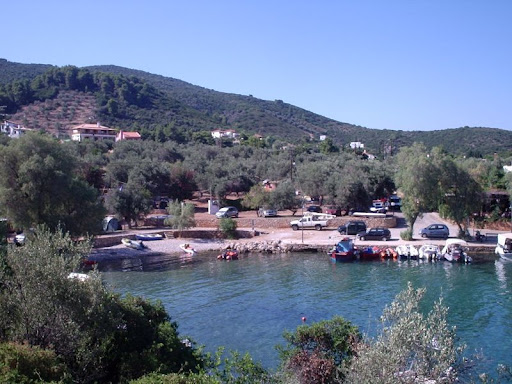
On approaching Steni Vala by the coastal path, I didn't have to wait long: the campsite enjoys prime position right behind the beach:


If you look closely in this photograph you can see a tent just overlooking the beach behind a boat which is pulled up on the pebbles -- a pitch which, if not always the most private, certainly affords a wonderful view. Also impressive was the scale of the site, an important factor if you are to secure sufficient grounds around your tent to give you enough privacy. Taking a walk around the perimeter fence I could see that it stretched back some ways from the beach end, getting quieter and quieter the further one chose to be from the sea.

Although I never entered the site and have no idea what the facilities are like, I would say that little Steni Vala's campsite is worth a visit especially if you value peace and quiet and the tranquil atmosphere of a little harbour. However, it is probably an option to move on to after first having located to the south of the island or, like me, one to return to on a second visit.

Moving on round the bay, I enjoyed spotting which nationalities had moored here by the flags adorning the yachts, and once more allowed myself to be carried away by the little fantasy of one day owning one. Then it was a quick visit to a cafe for a frappe, to stock up with water, make inquiries about bus times back to Patitiri and, seeing as I was in the mood to explore a little more, make inquiries about the onward path to Glyfa, the next beach to the north.

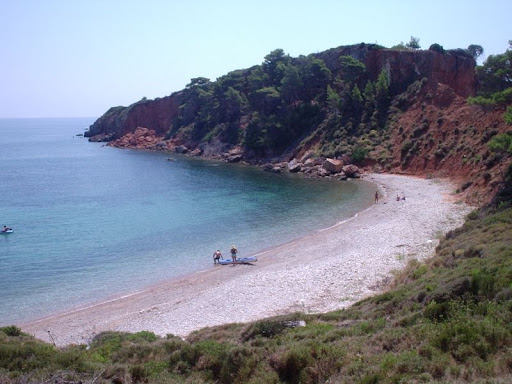
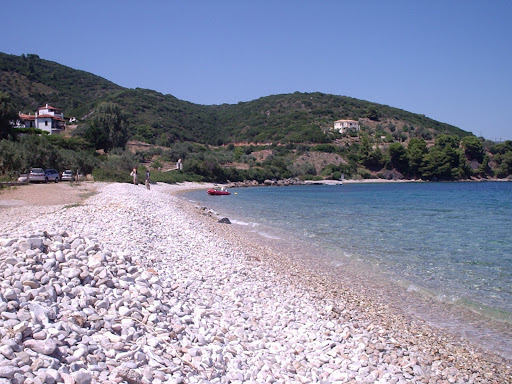
As it turned out, I had a good two hours or so until the last bus so I set off round the coast once more relaxed and unhurried. Glyfa beach, situated some five minutes from Steni Vala was a real treat: a long, smooth white pebble beach with clear water and only minimal construction in the large area of olive groves behind. The kind of place where you could spend an afternoon with a good book and hardly notice a soul around you.

Glyfa beach: quiet with clear water... but bring a pair of bathing shoes!

More than this, climbing the low hill at the far end of the beach takes you onto the main road again for all of 2 minutes where you can descend a little onto the patch of land heading down to the coast to find a little secluded cove all to your own. However, one thing you must be very careful of on this stretch of coastline is sea urchins. They seem to thrive on the combination of smooth pebbles and clear unpolluted waters, and are by no means always apparent from the shore... as I can testify. I had plunged headlong into the water at Glyfa and was gaily splashing around when I suddenly noticed the bay beneath me was a mindfield of sea urchins! Best to get yourself kitted out with a pair of hard soled bathing shoes, available in local shops, before getting into the water along this stretch.

As I still had the time and the energy, I thought I might as well push on further north on the asphalt for a while to see what sights lay in store after Glyfa. However, when I reached nearby Kalamakia, another fishing harbour lined with tavernas, but nowhere near as cute as Steni Vala, I could see that there wasn't much more mileage I could get out of this stretch on foot and that it would be better to return to this stretch the following day... this time with some wheels.

So that's exactly what I did, on reaching Kalamakia, I took a walk out onto the little jetty to better see the lay of the coast line further north. Tantalisingly, Agios Dimitrios with its triangular shaped beach could just be made out. This would be on the cards for tomorrow, but first the gentler rhythms of the evening beckoned... as did my bus back to Patitiri.

Saturday, 5 January 2008

The Pink Route: Trekkers' Etiquette OR Alonissos Travelogue Part 13


The reader of this travelogue will by now be well-acquainted with the landscape and paths of Alonissos. Thus there are no surprises to begin this, the description of the third and penultimate of my walks on the island: the route from Patitiri to Steni Vala. This is particulary the case given the fact that the first leg of this walk is exactly the same as that of the white route, taking the walker from Patitiri to Mega Nero via a pleasant detour off the main road to the hora.

Indeed, after this stretch there is little else of note till at least half way to Steni Vala. Which is not to say that the initial stages of this route are dull or in any way unpleasant. It is rather that in comparison to what lies ahead, the route that takes one from Mega Nero to the half-way point on a quiet dirt road interspersed with short spells lopping off a bend or two via a quick jaunt through a glade of pines is simply a pleasant stroll...


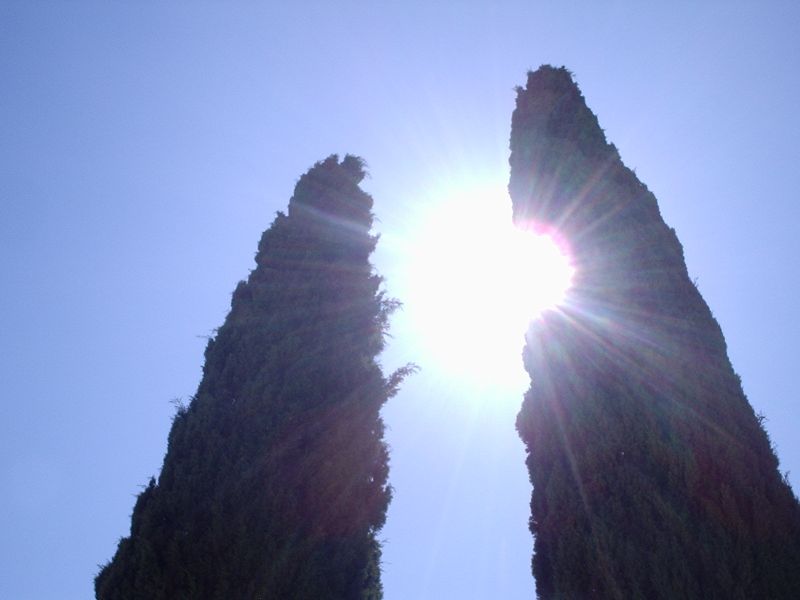
Twin cypresses snapped on the dirt road through Rahes, stage 1 of the walk to Steni Vala

... the real work begins when this dirt road hits the main road at the northern edge of the region known as Rahes.

On connecting with the main road I knew I had a kilometre or so on the asphalt so I whacked on my ipod to enjoy Giannis Parios' Nisiotika in the kind of landscape that they were written for. I must have got through about 4 or 5 songs by the time I reached the beginning of the footpath to Steni Vala. Here at the right hand side of the road lay a sign beyond which a dirt path descended into a lush valley scarred by the grey stony vein of a dried up river bed. I had found my way to the middle of the island and the sea, though visible to my right was not yet my immediate destination. First I would have to follow the river bed for a whiles before ascending a table topped hill onto a rocky plateau. This was more like it I thought, unhooking my earphones and silencing my ipod.

Then it was off down into the ravine, hopping from one smoothe sun-bleached stone to the next and all the time looking out for the familiar red splotches of paint that would tell me when to leave this river bed and start ascending the dark bulk of the hill to my left. After a little whiles, the way-markers appeared and I cut sharply north, first through an olive grove, then over a low wall, and eventually into the thick shade of some deciduous trees where I started my ascent onto the plateau.

This was exactly the kind of challenge I needed after the Sunday stroll along the dirt road. The path was becoming steeper, composed now of exposed rock steps leading me, bouncing on the balls of my feet, with ever increasing levels of endorphines, ever upwards through a mosaic of sky and branches.

Hitting the top of the hill, I found myself, as the guide had described, skirting the perimeter fence of a stable stuffed with goats and surrounded by quacking ducks before entering out onto a dirt road... whereupon I came face to face with a lost Greek holiday couple in a car whom it pleased me to set off on the right path, with an appropriate wish I might add, in their own language.

And that is the thing about Greek: it seems to have a wish for every occasion. In our, in this case, impoverished tongue, we can only muster the following set responses for occasions of non-celebration:

Have a nice meal!
Have a nice trip!

And perhaps 'Have a nice walk!' and other wishy-washy combinations along the lines of:

'Have a _____!'

But in Greek one can, and indeed, at times, should, come up with one of the following on parting depending on the occasion:

Kali douleia! = Something like 'have a nice working day'.
Kalo dromo! = Something like 'have a nice trip' but for driving; or 'safe drive'
Kalo banio! = 'Have a nice swim'
Kali diaskedasi! = Literally 'good entertainment' but in my experience seems to be the kind of thing that is said when one needs an all purpose, non-specific wish as is the case with
Kali sineheia! = which means something like 'keep on keeping on'!

As is so often the case with exclamations, one can feel a little strange using them if they have no equivalent in your language -- no doubt because they lack an emotional connotation for the non-native speaker and are thus too close to empty gestures. In fact, although I have been speaking and living with Greeks for 8 years now, I still do not feel completely comfortable with them.

So it was that at the close of my conversation with the lost Greek couple, having shown them where they were on the map, I made them endure a pregnant pause as I, aware that a wish was required yet unsure which one would be appropriate, detained them a moment or two before releasing them with the utterance:

Kali Ekdromi! = 'Good excursion'

By the looks on their faces, it seemed that this would do and off they went, bound for Steni Vala, as was I... but by an considerably more scenic route.

Wednesday, 26 December 2007

The White Route: Curiosity finds the Path... Or Alonissos Travelogue Part 12

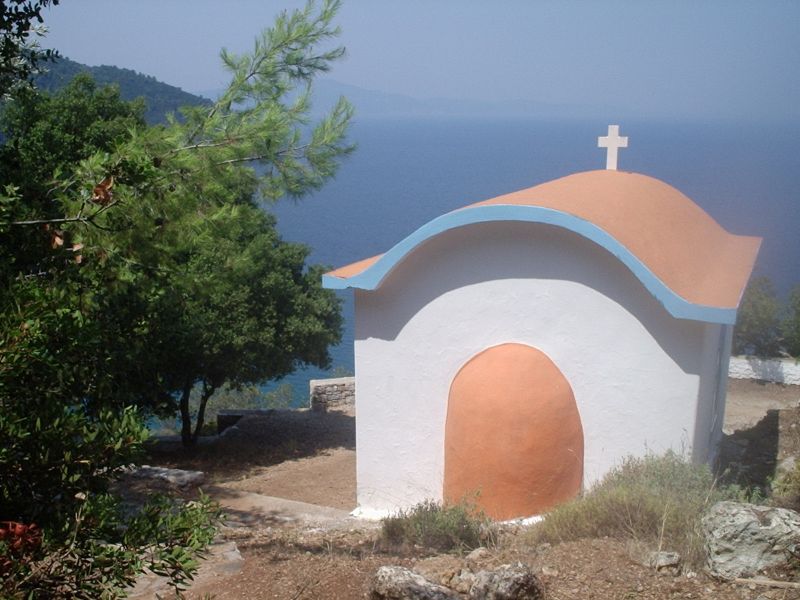
From the coast at Tsoukalia, an asphalt road winds inland up a gentle incline to connect after 30 minutes walking to the area around Mega Nero. A little whiles before this point, at about 20 minutes from the coast, a dirt track heads off through the pines to the north in the direction of the little cliff top chapel of Agioi Anargyroi. It is a pleasant, if storyless little jaunt, taking in ever more satisfying glimpses of the sea through the pines until one arrives after another 20 minutes or so to the chapel itself.


As you can see, it is a singularly picturesque spot - although one, admittedly, which is endlessly repeated throughout the Aegean - and must be even more breathtaking in the softer colours of a summer evening when the sun dips down low on the facing horizon.

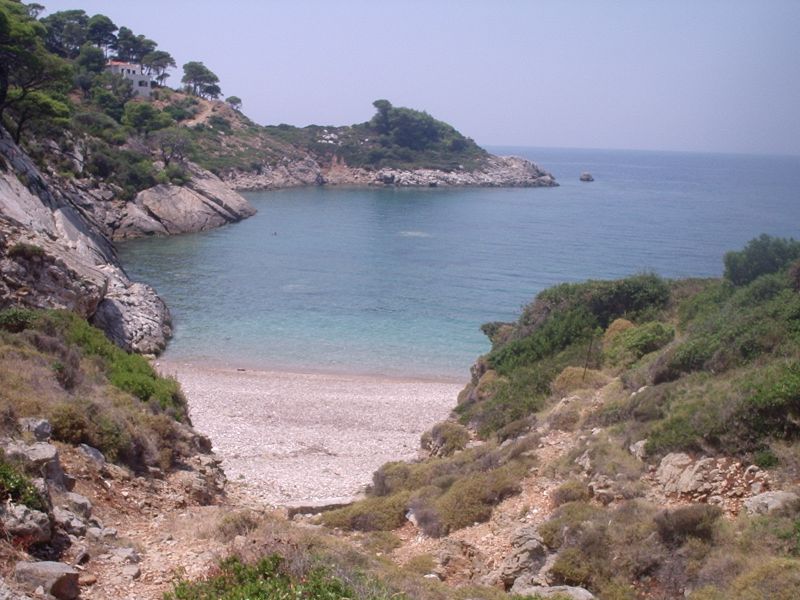
It is also a blessed spot in that it is situated in the general locale of some secluded little coves, offering the, by this time rather exhausted walker, an opportunty to cool their feet in the Aegean. To reach this area, known as Tourkoneri, one need only descend via a pleasant shady track through the pines which after ten minutes, will bring you to the grounds of a single house situated in an enviable poistion overlooking a sheltered bay.


You can just glimpse this house in the top left hand corner of the above photograph. However, one cannot see this little cove, where I swam naked for half an hour or so in complete isolation, from the path leading down from Agioi Anargyroi. In fact, on arriving at the coast by this path, one is met by a dirt road which, if followed, would take one back up inland eventually to meet up with a bigger dirt road running parallel to the main road through an area know as Rahes. This would be my route home; but before then, I fancied exploring the hidden inlets and coves on this part of the coast... but how?

The answer came, as usual, after a brief period of curiosity.

Leaving the house, I walked along the dirt road past the baking bodies jostling for a little more room on the tiny cove which was Tourkoneri proper, and up and a little inland on the dirt road. Sensing that this was the same road marked on the map and that it would soon take me back in the direction of home, I sought a little shade under a pine tree growing at the edge of the road to get my bearings once more. Looking up from my map at one point, I saw that I was actually sitting on the top tier of a stepped olive grove which wound around a little cove in an elegant arch, hugging the horse-shoelike contour of the land. Not only this, but there, a couple of tiers down below me and only just discernable, was a path which followed the countour of the olive grove first inland then back out again on the finger of the opposite peninsula. Once again, a little disinterested curiosity had shown me the way forward.

Getting up and following this path, I was led to a gate beyond which the path forked, with one route heading up onto a cliff-top path and another heading down the peninsula in the direction of the bay. Taking this latter path, I found myself after 5 minutes at the secret cove snapped in the photograph above and, confident that I would have the place to myself for a good while, stripped off for a highly refreshing and much needed skinny dip.

Refreshed and ready for yet more walking, I took to the cliff top path in good time to admire the view of a tourist kaiki gliding into the bay below me, the passengers of which would have got an extra little thrill if they had arrived five minutes earlier. From here, the path descended once more to the coast for the remainder of the walk, all the way to Megali Ammos beach in fact, alternately looping around little coves and out onto the rocky fingers of interposed peninsulas.

All in all, it was a beautiful and none-too-demanding stretch to top off what had been a long day's walking. So long in fact that when I got to Megali Ammos, I realised that this was as good a place as any to call it a day and head back to Patitiri on the wide road through Rahes...

... A route that I would revisit the next day on my way to Steni Vala.

Sunday, 23 December 2007

The White Route: Sherds, Sherds and More Sherds OR Alonissos Travelogue Part 11

Over the years, I have steadily added my own touch to the standard Greek holiday activities of swimming, trekking and eating. First there was fishing, a fleeting fad brought to an abrupt end when Maria arrived on the scene with her swift judgement that no man of hers should come within down-wind smelling distance of fish, nevermind 'murder' them. Next, there was an equally fleeting love affair with geology which for the most part saw me needlessly burdening myself with interesting looking rocks in the course of a holiday's walking only to chuck them all away at Eleftheros Venizelos airport flummuxing thus the odd itinerant geologist. And of course there has always been a healthy interest in cafes, with many an evening spent combing cycladic alleyways in search of the perfect view to accompany a sundowner... or two.

But none of these myriad ways to eat up time when not actually trekking or swimming can come close to the thrill of amateur archaeology. I always had at least passing interest in exploring the rich variety of ancient sites to be found on the islands, but it was not until I met Maria that my wall climbing and earth raking took on a more serious air. With 13 years spent studying the ancient artefacts of the Aegean, as well as practical experience of excavations, she was well placed to point me in the right direction.

Not that there was any great secret about it: all she did was make a casual remark while climbing up a low hill on the site of a Mycenaen Acropolis near Naoussa, Paros in the Autumn of 2004

"This place is full of pottery", she remarked.
"Really!? Where!?", I responded whirling round and raking the panorama less it should fly off like some startled bird
"Under your feet silly", she added tramping on ahead.

I looked down. She was right; the entire site was strewn with fragments of rust coloured sherds. What seems so painfully normal and obvious 3 years later - that even the most scrupulously excavated ancient site will contain traces of pottery - seemed like a revelation back then. I bent down to take a closer look, picking up an interesting sherd and rolling it around in my hands, only to toss it aside when a brighter or bigger one caught my eye.

Simply put, this discovery was a revelation, and even more so when I found fragments of fine-wear vessels whose light black brush strokes made even Maria excited.

Since then, I have always kept a keen eye out for finds, especially while exploring the more remoter sites, and thus have unearthed such finds as fragments of bronze, cup marks and even obsidian flakes in addition to scores of interestingly painted sherds.

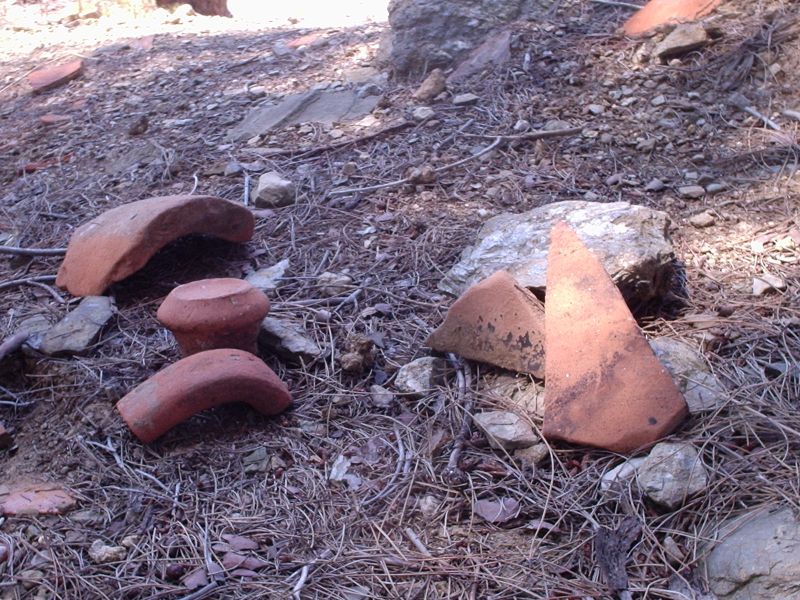
But I had never seen anything like the amount of sherds scattered around the unexcavated site of the classical era pottery factory at Tsoukalia. Not only was the beach thick with ostrika, many of the chunks were sufficiently large enough to incorporate whole handles and lips. Here are just a few of chunks that I found lying around.


However, despite this wealth of finds, I found the location of Tsoukalia to be a little disappointing. Although initially impressive, on closer inspection the vast array of pottery appeared to be composed almost entirely of coarse wear, with few indications as to which period, ancient or not, they might date from. Also, the beach too was a little uninviting as the prevailing northerly winds had raised the waves and chased a fair amount of rubbish into the bay.

So it was that having clambered about in the sherds for while, exchanging first one then another for a brighter, bigger chunk, I decided to hit the road again, this time bound for the picturesque chapel of Agoi Anargiroi.

Tuesday, 11 December 2007

The White Route: A to E via Q, Z, and X... OR Alonissos Travelogue part 10

Looking back on my ten days of walking on Alonissos, I am on the whole proud of my little adventures: not only did I cover a hell of a lot of terrain, I did so with the minimum amount of getting lost. Equipped with an accurate map, two independent descriptions of each route and most of all, the patience to study the lay of the land and the position of the sun with some degree of accuracy, I almost always made my way from A to E via the logical progression B then C then D.

The spectacular exception to my otherwise impeccable sense of direction came during the next stage of the white route from Mega Nero to Tsoukalia. On paper this stretch appears impossible to cock-up, not least of all because a sign-posted asphalt road separates the two locations by all of a 30 minute walk. However, on leaving Mega Nero, little did I know that I was about to embark upon an unplanned excursion up a mountain.

In my defence, I was subject to mitigating circumstances: I had set out on this route backwards.

Flashback to the early morning of that day. Andrew sits outside his tent, drinking coffee and studying the map...

... So where do I want to go today?.. Tsoukalia, yes... Oh and here's the walk to Tsoukalia in the guide book, excellent... but wait a minute... this route goes first north to Megali Ammos before taking in Tsoukalia on the way back... I'd much prefer to go the opposite way... I wonder if it is possible to follow the directions from the end of the walk and work back to the beginning and still be able to follow the route?... let's try... [...] ... seems easy enough, all I have to remember is that left is right and right is left... got it. Piece of cake!

And it was... right up until the point when I was directed to walk up a gorge.

I think you may be one step ahead of me here... but let me pull you back a little to walk a ways with me in ignorance so that I can tell you how it all happened.

Like I said, an asphalt road links Mego Nero and Tsoukalia, but the route described in the guide neatly avoids this completely by following a dirt track beginning some metres before the turn off to Tsoukalia, and leading one on a path through a charmingly sheltered patch of pine forest. In fact, this path penetrates so deeply into this patch of woodland that after fifteen minutes or so, the road disappears from sight altogether. It was at this point that I understood that I had to turn right; that is, had I been doing the route in the direction that the authors intended, I would have been directed to turn left at this same point having just emerged from the direction in which I was now about to set out...

...Got it? Not so easy after all, eh?

Anyways, what threw me here was not the cat's cradle of figuring out left from right, this was relatively simple; rather it was the more prosaic yet infinitely more frustrating situation of being confronted with 2 possible rights. Indeed a path did slope down away from me to the right, but on closer inspection, this forked after 10 meters or so leaving me with no indication just which of these two rights I should take.

The intrepid walker will often be faced with this very dilemma, though it should be the aim of all guide books to eliminate the agony of such 'russian roulette' moments. In practice one must call upon all one's resources to make an informed choice: the lay of the land, the position of the sun, moss growing of the northern side of tree-trunks (and other such 'boys' own' fun). However, in those cirumstances where doubt persists, there is no other solution than to choose a path, set out, and seek to confirm or reject your groundless hypothesis by checking the lay of the land against the description of the route.

Choosing the left fork, I wandered down a wide path flanked on one side by pines and on another by an olive grove before arriving at a little track which left the wider path to the left and led me into a shallow gorge. As all this checked out against the description of the route, adjusted, naturally, to compensate for my backwards direction, I felt confident that I was now within a brief walk a Tsoukalia.

Safe in the knowledge that I was well and truly on track, I paused for while in the little gorge to enjoy the silence. Just where I had entered, a handful of olive trees stood in a flat patch of long grass, sheltered from the elements and presumably well watered by what would have been a seasonal stream. Although I must have been a short walk from the road leading down to Tsoukalia, I might as well have been in the middle of nowhere; so quiet it was. Paradoxically perhaps, the sense of peace was made more intense by two hawks which at that moment were circling above me, plaintively screeching and every so often swooping close enough for me to hear their wings cutting through the air.

Perhaps it was the fact that I was caught up in the atmosphere of this little place; perhaps it was the sense that the difficult part was behind me. Whatever it was, when I got up and looked at the map to figure out in which direction I should walk to get to Tsoukalia beach, I did not walk down the gorge as common sense would dictate, but up it. What had momentarily escaped my attention was that when you read route directions backwards, not only should left be read as right, but following a similar topsy-turvy logic, up the gorge should actually be rendered as down it.

Think about it...

So with a spring in my step, a song in my heart and two harbingers of doom screeching and swooping above my head, I set out to ascend the gorge.

Two minutes later I hit a dead end: a dense thicket of thorns blocked the conventional ascent up the bed of the gorge. No worry, I thought as I took to a narrow and precipitous goat track ascending sharply up the right face of the gorge. Within a further twenty metres or so, this petered out, as so often is the case with goat tracks, leaving me to rely solely upon my sense of direction to see me through to Tsoukalia (which, as you will no doubt realise, was situated at an ever increasing distance behind me.)

Things went from bad to worse. The terrain became first steep and rocky, forcing me up ever higher onto the mountain and away from the gorge, then, when I had hit a sufficiently high enough altitude as to impress upon me most forcefully that I was definitely not headed for the coast, I found myself in the midst of a dense thicket of hollyoaks. The sun was pretty high at this point, and I was running desperately low on water too. And to top it all, the hawks were still relentlessly pursuing their quarry high above me. But despite all these set-backs, I remained cheerful: there are precious few opportunities to feel like a hero in this day in age... especially if you are the English teacher in a small provincial German town.

Eventually I broke out of the cover of the hollyoaks to see a little church crowning the ridge at the head of the gorge, which I could now see as a dark gash into the landscape way below me. Checking this against the map, I realised it must be the panagia sto boyno and knowing it to be loacated in the direction of a natural spring, struck out for the little church. After a few moments I came to some residential houses and a dirt road, and with half an hour I was drinking cool clear water in the shade of the little church.

Having quenched my thirst, I took stock of my situation. I still couldn't figure out what had gone wrong down in the gorge, but that mattered less than trying to salvage the walk. A glimpse at the guide revealed the answer: if I were to retrace my steps back along the dirt road, away from the church in the direction of the houses that I had seen, would come to the end of the road and a large property surrounded by olive groves. Arriving at the gate of the yard of this property, I should follow the perimeter wall in search of the familiar red splodges of paint upon boulders that seem to act as way markers throughout the Aegean.

Sure enough, as soon as I left the gate of the house and entered the olive grove, I found a string of way markers which eventually started to lead me back down the mountain. After a short while I entered pine forest again and the path began to get steeper and steeper... and every so often as I glimpsed the sky between the pines I could see the pair of hawks circling, swooping and screeching.

It was a beautiful walk, as usual accompanied by a symphony of sights, sounds, and smells: again the air moving through the trees, again the heady resinous scent of the pines; but this time the kind light of the forest floor and everything punctuated by the mournful screeching of the hawks, whom I was now considering less as harbingers of doom and more as companions on this little adventure.

After a while, I reached the edge of the forest and as is so often the case in dear green Alonissos, the beginning of an olive grove. Here, the ground became ridiculously steep, necessitating my gingerly proceeding crab like, inch by inch down a rugged track. But this was to be the last obstacle. Soon the landscape gave way to gentle tiers of olive groves affording a view of the last leg of the asphalt road down to Tsoukalia.

On hitting the road I heard the sea, which soon revealed itself... as did several hundred thousand pottery sherds.
.

Monday, 19 November 2007

The white route: spiders, cypresses, startled fowl and springs OR... Alonissos Travelogue Part 9


Having picked Dave and Gerry's brains about where to go the previous night, I thought it might be nice to walk to the beach of Tsoukalia on the South West coast to take in the as yet unexcavated classical era pottery factory located there, before looping up a little further on the west coast to visit the picturesque church of Agoi Anargiroi and the nearby coves of Tourkoneri and Megali Ammos.

It would be a long walk, all of eight hours what with breaks and swimming time, so I set off nice and early bound for the starting point of Patitiri... and the harbour shop to get myself my breakfast of a little tub of 'Total' yoghurt with a couple of miniature preserves of honey. This I slowly savoured under a tree down by the harbour, enjoying the comings and goings of a work-a-day port.

As with the red route, this white route starts with a thoroughly pleasant stretch once you clear the perimeter of Patitiri. The path proper begins at the first hairpin bend on the road up to the Hora where a sign for Mega Nero, ostensibly pointing at the house situated on the bend, but actually sending one up a slope skirting the perimeter wall of the house, leads, after a couple of minutes, into the familiar Alonissos landscape of pine forests and olive groves.

It was amazed to find this Arcadian stretch with its herb strewn paths and surprisingly dense thickets of ferns so near to the main road up to the Hora. It seemed like I had been transported into a different land on clambering up that little slope -- an impression made all the more forceful by the fact that one emerges into the little glade from the relative darkness of a thick kopse of pines.


I was used to seeing such undergrowth in the forests and moorlands of Scotland, but not in the Aegean in late July!

I should also add that other attractions on this five minute stretch included...

A: Startling some kind of wild fowl on rounding a bend (being Scottish I would identify it as a grouse or partridge or something like that, but I feel sure this can't be right). It had been hidden from view in the kind of thick undergrowth you can see above when this lumbering giant happened along, causing it to take to the sky with much clucking, flapping and fuss (beware of spoonerisms here).

B: Taking a momentary wrong turn on my way back through this glade and briefly entering the narrow channel of a track that, by the looks of things, hadn't been used in a while. I was quite sure of this as no sooner had I entered the space between the two hedgerows than I found myself gazing eye to eye with a huge spider (and I mean big enough to make the author yelp expletives of terror and surprise) perched horny and crab-like in a thick spun web which totally sealed the entrance to the path.

C: Cypress trees. Three of them. Baby ones. I do like cypress trees.

After this idyllic little stretch, I emerged at the spring of Mega Nero. Here, in a little depression surrounded by fields, was a rough build concrete trough in which a couple of taps had been inserted. As I ventured closer to fill up my bottle with the cool water, bravely sweeping aside the clouds of thirsty wasps grazing from the droplets clinging to the underside of the taps, I once more wondered just how it was possible to have the miracle of fresh running water in this parched land. As I had learnt the previous night from Dave and Gerry, those islanders who weren't fortunate enough to be connected to the mains water supply had to make do with collecting and storing what rain water they could by their own means and filling up the rest of the time from springs such as this one. It was another hot day, the earth was cracked from weeks, if not months of drought; yet here was an abundant reserve of water which was not only openly available to all, but which at that moment was leaking its way back into the earth by virtue of numerous instances of careless plumbing.

My water bottles replenished, my hair soaked with cool water, I was ready for the off once more. So, greeting the old woman gathering the lush sprigs of horta thriving in the midst of this little oasis, I hit the road.

I guess I should start publishing these walks in installments as they are growing way beyond control and heaven forbid that I should bore the few people who aren't even reading anyway.

Off the beaten track and back for a beer OR... Alonissos Travelogue Part 8

The day after the red route, I walked up the eastern side of Alonissos as far as Chrysi Milia. It was a nice walk at stretches, especially the cliff top path north from Spartines beach where I snapped the following photo:

View of second, more northerly Spartines beach from the cliff top path between the two beaches

But besides this stretch, however, it really was a bit of a disappointment. It was the one time that I abandoned the guides and set off in search of that most satisfying route: the coastal walk. One of the first places in Greece that I ever went walking was on the south west coast of Crete. Here, in the region of Hania, where the White Mountains tumble into the Libyan Sea, are miles of coastal paths stretching almost the whole length of the region. With the proximity of the sea on one hand and the mountains on the other, such walks are always a real joy.

Unfortunately, the topography of the south-eastern coast of Alonissos is such that no route can feasibly be undertaken over the jagged outcrops, scree-strewn ravines and, at times, residential housing that characterise this coast. Time and time again I was forced to make headway on the asphalt, thus losing instantly that childish yet highly agreeable sense of being an explorer.

Anyway, when I got to Chrysi Milia after a 3 kilometer stretch on the asphalt to find the tiny beach packed with young families enjoying the only sandy beach with shallow water on the island, their young kids volubly voicing their wants, I decided that I had had enough. After a fruitless period awaiting service at the crowded
taverna, I phoned a taxi and escaped back to Patitiri where I beered and tramped cheerily back up to the campsite on my little path through the pine forest.

That night, I finally met up with Dave and Gerry and enjoyed a sociable evening up in the old town over a few beers and a plate of yemista. It was a chance for me to effervesce about many of things that I here describe as well as get a few tips about where to go next.

And so it was that awaking the next day, just a little fuzzy headed, with another day's walking ahead of me, I knew just where I would go.

Wednesday, 14 November 2007

The Red Route: A long way to come to watch bats OR... Alonissos Travelogue Part 7


I undertook the first part of this walk, from the campsite to Megalos Mourtias, on that first restless evening on the island. So it was that when I awoke the next day with this circular route in mind, I knew what to expect of the first leg. Flanked on either side by olive groves, one walks south from the campsite on a quiet asphalt road with the sea to your left, where occasional yachts are the only addition to a seascape punctured by scattered low lying islets. Soon, you meet a dirt track sloping up to the right: the road to Megalos Mourtias. Here, the scenery changes as you head east through pines with distant views of Evia to the south and facing you, the forested flank of Skopelos.

Although it was the first stage of my first walk on the island, this stretch was amongst the most beautiful of my entire tour, and, conversely perhaps, one of the most accessible in terms of walking surface and distance from the main settlements (drivable in a normal car and a mere 30 minutes on foot from Patitiri). Despite this proximity, it was, more often than not, completely deserted each time I visited it, leaving one to enjoy the views of the islands peeping out from behind the pines in perfect peace.

Substantially more relaxed on this first morning, with a corresponding tendency to the treat the walk as an end in itself, I was also much more in the mood for distractions along the way to Megalos Mourtias. To wit, I had already explored those off road curiosities which had presented themselves on the walk down the south eastern coastline, namely:

A) A narrow cove 100 metres or so south of the campsite, but unobservable from the road, and accessible only by bringing your own rope to scramble down the last three metres of sheer gorge face onto your own private beach.

B) Marapounda resort: A raucous Italian holiday village consisting of faux cycladic alleyways laid out around incongruously lush green lawns where, on the basis of my unintentional visit, every aspect of one's precious time away from the deadlines and demands of everyday life appears to be planned with boot camp precision (think megaphoned reps directing wholesome group activities). Mercifully, the considerate owners have fenced off the entire site thus preventing all but the most curious of walkers from stumbling upon the tackiness it conceals.

C) The remains, at the edge of a cliff just south of the cove and half covered in vegetation, of a very old dwelling place indeed.

Wall and steps on coast facing side of cliff-top dwelling, south east Alonissos

While unlikely to be of ancient origin, the position and state of this dwelling were of enough interest to the author to prompt a brief 'discovery of something important' fantasy.

However, perhaps the most entertaining diversion presented itself on attempting to gain access to the beautiful and seldom frequented beach of Vythisma at the very south of the island.

The descriptions of this beach in the two guides that I had read were alluring: remote, sandy, south facing and thus sheltered, and seldom frequented by reason of its unaccessability. Lying at the foot of a cliff, both guides describe how one picks one''s way down from the dirt road on a path strewn with fallen pines to arrive, tantalisingly, about 5 metres above the beach with a sharp drop separating you from the deserted sand below. Whilst such an descent is by no means difficult to negotiate (standing on the edge of the precipice one can easily imagine jumping down onto the soft sand below), the ascent back up again would ideally entail, if not a ladder, then certainly some rope.

However, the authors of the internet guide I have mentioned had found an alternate descent, one which, although far from straighforward, provided at least a means of getting off the beach without the assistance of a helicopter.

The description on their internet site goes a bit like this (but naturally I'm paraphrasing):

"...on arriving at the precipice, double back and search the path for a 'double trunked tree'. Just behind this tree, a fainter path runs parallel to the beach. Follow this through the pines for a few minutes until this path runs as thin as the sole of a single sandal and a vertical drop down a scree slope awaits you should you be unfortunate enough to lose your footing. At this point, place your faith in the sparse clumps of scrub like vegetation eking out an existence on the near vertical cliff face, relying on them to take your entire weight as you abseil inch by agonising inch down to arrive eventually at a ruined drinks kiosk. Here you will find something like a rusting postcard stand which you will greet as an ersatz ladder and again rely on it to sustain your entire weight as you once more inch gingerly but hopefully not bleeding too heavily, onto the sand."

I'm paraphrasing of course, but have added nothing but a flourish to this description; in its essence it is as the authors descended onto Vythisma, post card stand and all... I know 'cos this is exactly what I did too.

You gotta hand it to them: they were intrepid explorers with a keen desire to enjoy the delights of the remote and beautiful Vythisma. However, what they and Keller and Tsoukalis fail to relate is that an alternative and incredibly straightforward descent exists.

There are in fact two paths descending from the dirt track down to Vythisma: the first one encountered on approaching from the east leads you into the aforementioned Harold Loyd like japes; the second, however, situated some 10 metres further on toward Megalos Mourtias, leads you down on a relatively simple jaunt through the pines. After five minutes or so the beach swings into easy view and one passes a ruined portocabin whose Greek sign reading "please do not break the door: nothing of value is kept inside", written as it is on the wrecked remnants of the said door lying some feet away on the forest floor, provides brief entertainment. Just below this, a slightly damaged stone staircase begins which leads directly onto the beach.

It is indeed curious that neither guide, whilst obviously written by those in the know, mentions this far simpler descent. And it's not as if the staircase is particularly difficult to locate when on the beach: I had found it within five minutes of the 'conventional descent'.

So finally on Vythisma with no worries about extracting myself off of it, I was in the mood to take a few photos:


As you can see the shadows in this photo are pretty long: I guess I did get up pretty early that morning. But here, in all its glory, is the ruined drinks kiosk:


Onwards from Vythisma, it was my pleasure to take a swim at the popular beach of Megalos Mourtias, which, at that time in the day, was agreeably empty. Then it was off and up to the Hora on the hiking trail which provides a neat way of avoiding the asphalt.

This part of my journey was again a joy. Starting as a scramble up an embankment off the main road just outside Megalos Mourias, the hiking trail up to the Hora crosses the road once more before ascending steeply on a thin trail parallel to the perimeter wall of the tennis court of a private house eventually to lead one to a tiny kops of trees and bushes which provide sufficient respite from the sun to gather your breath and admire the views back down to Megalos Mourtias in comfort. It was here, neath this little green kops, that I had one of those moments of quiet euphoria which solo walkers are often prone to. Whether these can be put down to a quasi-spiritual affinity with nature, or, as I would believe, the body's unfamiliarity with endorphines after months of sedentary slothing matters not; the point is that such experiences have always accompanied my trips to the islands and have, like the light and the mythology, contributed to making the Aegean the wonderful place that I feel it to be.

And so to the Hora itself.

I found myself there almost my accident, so involved was I in the rhythm of the walk. But, grateful for the opportunity to distract myself with coffee and company for a while, I headed to a cafe where I spent a good hour or so admiring the view and lapping up the entertainment provided by holidaying Greeks. To wit, a story:

Having sat for some 3/4 of an hour on the terrace of a traditional coffee and cake shop, the relative peace and quiet of the post lunch lull was shattered when a group of four well-to-do Athenian ladies sporting voluminous and colourfully printed beach smocks, huge wide brimmed floppy hats and chunky YSL fly-goggle sunglasses burst onto the scene with copious ooohs and aaahs at the view that greeted them. There was further cackling and chaos as they debated the relative merits of locating at one of the three free tables and indeed who would sit where once the table had been decided upon (in the sun, in the shade, facing the sea, nearest the toilet, etc.). Finally, when they were all settled, each to their satisfaction, and any normal person would think that they could do no more to make a spectacle of themselves, the girl brought out the sweet menu and the little party erupted again into ebullient life .

This was too good to miss. There are few types in this world who take the ritual of coffee and a cake as seriously as well-to-do Athenian ladies. Sure enough they began cooing as soon as they set eyes on the array of home made sweets on offer.

It was at this moment that the loudest and most colourful one among them, the leader if you will, took the initiative and, grabbing the menu from out of the clutches of an unsuspecting other and pausing only for as long as it took to gain fully the attention of the entire coffee shop, proceeded to intone the names of each dish with a lusty suggestiveness whilst the others sucked air in sharply through pursed lips and repeated: kataifi, ffffooo!... soutzouki, ffffooo!... melamakarona, ffffoooooooo!

However, when it came to the crunch, this was as far as her gang were prepared to go. Content just to roll the words around in their mouths, they each declined to order from the gooey menu for fear of compromising their figures in what is Greece's most diet wrecking season.

Their leader would have none of this. With the kind of extravagant gesture all too typical of a Greek in the grip of kefi, she ordered four plates of the richest gooiest and most expensive sweets on the menu, reasoning perhaps that by the charm of her extravagant gesture alone, her minions could be persuaded to join her in her indulgence... and thereby, perhaps, sanction it.

It was a bold move, and one which, I remember pondering as I looked on at her savouring the first morsels in an orgy of ostentiation, might have worked... if it were not for the untimely intervention at that very moment of their tour guide with his sudden declaration that their bus would leave from the main square in five minutes.

What would you have done?

She didn't let herself down. True to her plan, she continued to entice her friends to join her in finishing off the four ample plates piled up in front of her. Again and again she petitioned them and again and again they declined, each time giggling a little more at the sight of this well-to-do Athenian lady, replete with all the accessories of her position, gorging herself on the gooiest of gooey sweets, firmly convinced that she would, by her example, persuade the others to help her out of what was becoming an increasingly intractable situation.

Eventually, inevitably, she accepted that circumstances had gotten the better of her and that she was all alone in her crusade to champion these homemade delicacies; but to her credit, she held fast to her course and continued to praise them, now through smaller mouthfuls and more sympathetic laughter, right up until it became time for the cabaret to leave.

Such consumate entertainment is the stuff of dreams. My entertainment gone, my frappe finished, I paid the girl and took to my feet once more, this time bound for the picturesque beach of Gialia.

I had wanted to visit Gialia for some time because of the impossibly picturesque appearance of the little beach: situated at the head of narrow inlet and neatly offset by a wind-mill. The walk down was without event, plodding away on a dirt track downward, ever downward toward the coast.

Gialia beach

Here I stopped for a brief swim, then snacked on some soutzoukakia, picking out the saucy meatballs from the tin with my fingers. It was by now around 3 o'clock in the afternoon and very hot indeed. I had been walking since about eight in the morning, had just eaten, and quite frankly was in need of a little snooze. All this I barely registered as I closed my eyes, savouring the touch of the sun upon my skin and the knowledge that I could lie here as long as I damn well pleased.

When I awoke the sun was just a little lower in the sky. Refreshed, I rolled up my psatha, picked up my bag, took a long swig on my water bottle and readied myself for the upward march back to the main road

What actually happened after I reached the main road is far from interesting and would involve travelling on through a beautiful yet storyless landscape back to the campsite. So let us travel back by a more entertaining route...

I had that evening travelled back to the old town by bus to see if I might be able to meet up with Dave and Gerry, but had succeeded only in meeting their cats and scoring an ouzo and sunset mix back at the cafe where I had enjoyed my afternoon entertainment. It was now around half eight and had, by kilometres as well as hours, been a long day, so I decided to call it quits and head back to the campsite for a well earned rest.

Now I could have taken the bus... as I walked past the square, one was due to leave in a little under half an hour; but it was such a beautiful night and I was so captivated by walking on the island that it felt like a betrayal of my purpose to take the bus back when I could walk on the old kalderimi back to Patitiri and from thence on a fifteen minute jaunt through the pines to the campsite. So I stopped in at the shop for a little retsina and that is exactly what I did.

Strolling down that dusky kalderimi with my destination, the sea, a dark band between the treetops and the azure blue sky, was a perfect end to my day. With my little bottle dangling from my fingers and a song in my heart, I drew out my steps to savour the colours of the dying day: the golden fields of the hora where the sunset still reddened the sky; the shimmering silver of the olive trees as they lost their colour with the dusk; and eventually that murky little glade where I watched the dark silhouettes of bats flit against a dull metallic sky.

I must have spent a good half hour watching them flit to and fro, and these days, some 4 months later, it is this memory more than any other that dominates from that first walk.